A skiing holiday can begin with a surprisingly long journey. Getting to a London airport, checking in bulky equipment, flying to Geneva and arranging transport into the mountains may occupy most of the first day. For families and groups with limited time away from work, choosing the right flight and transfer arrangements can make a considerable difference. Private aviation offers an alternative, particularly when travellers want to depart together and choose a schedule that fits their accommodation booking.
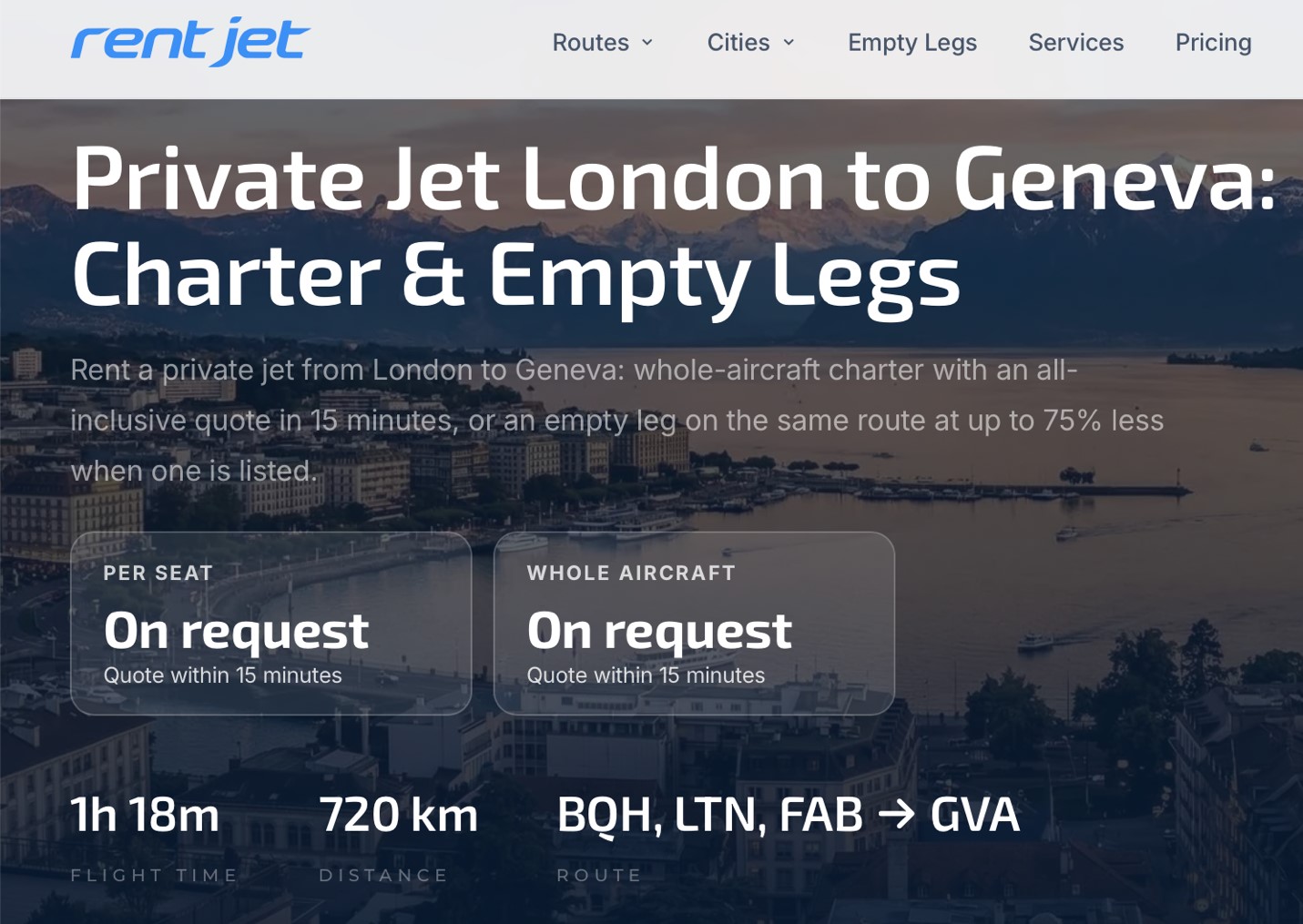
The London–Geneva route is well suited to private charter, with a typical flight time of around one hour and twenty minutes. Travellers considering this option can review the route at https://rentjet.eu/routes/london-to-geneva/ and request an aircraft quotation based on their dates and passenger requirements. Geneva Airport provides access to ski destinations in both Switzerland and France, although the journey from the airport to the resort can take considerably longer than the flight itself.
The convenience of a private jet does not eliminate the challenges of winter travel. Snowfall, road congestion, airport restrictions and the size of ski equipment all require advance planning. The most effective itinerary connects the flight with a realistic mountain transfer, allowing enough flexibility for weather and seasonal conditions.
Choosing a London Airport and the Right Aircraft
Private flights to Geneva can be arranged from several airports serving London, including Farnborough, Biggin Hill and Luton. The preferred departure point depends on where passengers live or work, the aircraft available and the intended flight schedule. Someone travelling from Surrey may find Farnborough convenient, while Luton can be more practical for passengers based in north London or Hertfordshire. Biggin Hill offers another option for travellers coming from the south or southeast of the capital.
A private charter allows passengers to request a departure time rather than work around a scheduled airline service. For a weekend skiing trip, an early Friday flight may provide enough time to reach the resort before dinner, while a later departure could suit travellers finishing work in London. The operator must still accommodate airport opening hours, aircraft availability and crew duty restrictions. A requested departure time is therefore subject to confirmation rather than an unconditional guarantee.
Aircraft selection deserves more attention on skiing trips than on many other short European journeys. Winter travellers often carry heavier clothing, boots, helmets and equipment in addition to ordinary luggage. A light jet may have enough seats for the group but insufficient storage for everyone’s ski bags. The aircraft’s baggage compartment dimensions can be just as important as its advertised passenger capacity.
Different business jets also have different performance and payload limitations. A group travelling with several sets of skis and large suitcases should provide accurate baggage information before accepting a quotation. Operators can then confirm whether the equipment fits safely or whether a larger aircraft would be more appropriate.
For the flight itself, a light or midsize jet will often provide sufficient range, subject to the aircraft’s specifications and operating conditions. Selecting a larger aircraft solely for a relatively short journey may increase costs without delivering meaningful advantages. Extra cabin space can nevertheless be worthwhile for families travelling with children or groups that place greater value on comfort.
Passengers should compare available aircraft together with their departure airports. An aircraft already positioned at Luton might offer better value than a similar jet that must be flown empty to Farnborough. Ground transport across London must also be considered before deciding which option is genuinely more convenient.
Getting from Geneva Airport to the Ski Resorts
Geneva is a practical gateway to several Alpine skiing regions, but the resorts vary substantially in their distance from the airport. Some lie relatively close to the French border, while others require a longer journey through mountain valleys. Choosing accommodation without considering the transfer can create an unnecessarily demanding arrival day, particularly when travelling with children.
Chamonix is among the most accessible well-known destinations. Situated beneath Mont Blanc in France, it can generally be reached from Geneva Airport in approximately 75–90 minutes under favourable road conditions. The journey can take longer during snowfall, heavy traffic or peak holiday periods. Travellers planning a short break may appreciate the relatively direct access, although Chamonix’s different ski areas can require additional local transport.
Megève is another established French Alpine resort within reach of Geneva. Its village atmosphere, restaurants and varied skiing make it appealing to families and travellers who want activities beyond the slopes. The road transfer typically takes around 75–90 minutes in good conditions, with additional time possible during busy winter weekends. The location of the accommodation within or outside the village can influence the final journey.
Verbier, in Switzerland’s Valais region, requires a longer transfer. The journey by road generally takes around two hours, depending on traffic and weather. Travellers can also reach Le Châble by rail and continue to Verbier using the cable car or local transport. This alternative may be worth considering when road congestion is expected, particularly on popular arrival and departure days.
Other destinations, including Morzine, Les Gets and parts of the Portes du Soleil ski region, are also accessible from Geneva. Their transfer times depend on the chosen resort, accommodation location and route conditions. More distant resorts such as Courchevel generally require substantially longer journeys and should not be treated as convenient extensions of a short flight.
Passengers choosing between destinations should consider more than the approximate driving time shown on a map. Road conditions can change rapidly in the mountains, and Saturday changeovers often create additional traffic. A resort that is farther away may still be worth the journey for a week-long holiday, but it could be less practical for a two-night skiing break.
Travelling with Skis, Snowboards and Winter Luggage
Transporting equipment is one of the practical reasons families and skiing groups consider private aviation. Travellers can remain together, coordinate their departure time and select an aircraft that accommodates their requirements. However, private charter does not mean that baggage restrictions disappear. Every aircraft has limits determined by available storage space, payload and safety regulations.
Long ski bags deserve particular attention because some light jets have baggage compartments that cannot accommodate them conveniently. Snowboards, boots and helmets also occupy significant space, especially when several passengers bring their own equipment. The operator should receive the number, approximate dimensions and weight of unusually large items before confirming the aircraft.
Families travelling with younger children may need additional space for pushchairs, child seats and winter clothing. These requirements can affect the aircraft selection even when the passenger count is relatively small. It is better to confirm the entire luggage inventory at the quotation stage than discover that equipment cannot be carried shortly before departure.
An alternative is to rent skis and snowboards at the resort. This can reduce the amount of baggage transported and make a smaller aircraft more practical. Many Alpine destinations have specialist rental shops offering equipment suitable for different skiing abilities. For passengers taking a short holiday, avoiding bulky luggage may also simplify transfers and hotel arrangements.
The decision between bringing equipment and renting locally depends on the traveller’s preferences, the duration of the holiday and the available aircraft. Experienced skiers may strongly prefer their own equipment, while occasional visitors may find rental services entirely adequate. Either choice should be included in the travel plan rather than left until the final stages of booking.
Ground transport must accommodate the equipment as well. A vehicle with comfortable seating for six passengers may not necessarily have enough luggage space for six ski bags and several suitcases. When arranging a private transfer, the booking should specify the number of travellers and the amount of equipment so that a suitable vehicle can be provided.
Planning Around Peak Winter Demand
Skiing holidays follow a pronounced seasonal pattern. Christmas, New Year and the February school holidays bring strong demand for accommodation, flights and transfers across many Alpine destinations. Saturdays can be particularly busy because numerous chalets and hotels organise weekly arrivals and departures on that day. Travellers arranging private flights should account for these patterns when selecting their dates.
Geneva Airport handles substantial winter traffic, including passengers travelling to resorts in Switzerland and France. Business aviation operations remain subject to airport capacity, available handling facilities and operational procedures. Private aircraft may avoid the main commercial check-in process, but they still require appropriate airport arrangements and cannot operate independently of air traffic restrictions.
Winter weather introduces another variable. Fog, snow, strong winds and reduced visibility can affect flights, while heavy snowfall may slow road transfers even when the aircraft arrives on schedule. The operational implications differ according to the conditions, airport and aircraft involved. Passengers should therefore avoid planning essential activities immediately after their expected arrival time.
Several decisions can reduce unnecessary complications when organising a winter charter.
- Book suitable aircraft capacity. Account for skis, snowboards, winter clothing and other equipment rather than relying only on the number of seats.
- Compare departure airports. Consider ground transport and aircraft positioning costs alongside the requested flight time.
- Arrange transfers in advance. Confirm the vehicle capacity, pickup location and arrangements for delayed flights.
- Allow for mountain traffic. Avoid scheduling arrival at the resort around an unrealistically short road journey.
- Check travel documentation. Passengers heading into France from Switzerland must meet the relevant entry requirements, even when crossing the border by road.
- Review the return schedule. Leave sufficient time to travel from the resort to Geneva Airport, particularly during busy changeover periods.
Holiday dates deserve a little flexibility where possible. Arriving on a Friday rather than a Saturday may help avoid some of the busiest resort transfer traffic, depending on the destination. Similarly, returning on a Monday can sometimes make the final day less demanding. The advantage depends on accommodation arrangements and the travellers’ commitments rather than applying equally to every journey.
Some visitors choose shorter stays during quieter periods instead of travelling during the most popular holiday weeks. This may improve access to accommodation and provide more choice when arranging flights. Snow conditions and lift availability still need to be checked independently, especially near the beginning and end of the ski season.
Comparing Private Charter with Scheduled Flights
A private flight from London to Geneva is generally priced for the entire aircraft rather than for individual passengers. This changes how costs should be compared with scheduled airline tickets. A group of several travellers can divide the overall charter expense, but the result is not automatically cheaper than purchasing commercial flights. The difference depends on the aircraft, date, number of passengers and total quotation.
Charter costs are influenced by aircraft category, airport fees, crew arrangements and positioning requirements. A jet that must travel to London specifically to collect passengers may cost more than one already available at the selected airport. For a return trip, operators must also decide whether the aircraft will remain in Geneva or undertake other assignments between the two flights.
Travellers should request a complete quotation that identifies the services included. RentJet advertises all-inclusive charter quotations covering the aircraft, crew, fuel, airport charges, taxes and standard catering. Ground transfers and additional services may require separate arrangements, so these costs should be checked when evaluating the total budget.
Empty leg flights offer another possibility for passengers with flexible schedules. These arise when an aircraft must reposition for another booking and can sometimes be offered at discounts of up to 75% compared with a conventional charter. However, the available route and departure time are determined by the aircraft’s existing commitments. A suitable London–Geneva empty leg cannot be assumed to exist for a particular skiing holiday.
For travellers with fixed accommodation dates or important commitments, relying on an empty leg may introduce too much uncertainty. These flights can be changed or cancelled if the underlying charter schedule changes. They are more suitable for passengers able to adjust their plans than for families who have already paid for a non-refundable chalet and booked several days of ski instruction.
Scheduled airlines also remain a sensible option for many travellers. Geneva has extensive commercial connections, and passengers travelling alone or as a couple may find that airline services provide a better balance of price and convenience. The comparison should include baggage charges, airport transfer times and the availability of suitable departure schedules.
Private charter becomes more attractive when several people need to travel together, carry substantial luggage or follow an itinerary that scheduled services cannot accommodate conveniently. Its financial value is therefore closely related to the group’s specific travel requirements rather than the flight distance alone.
Making the Most of a Short Skiing Holiday
A weekend in the Alps can be rewarding, but the margin for wasted time is small. A Friday departure from London may provide enough time to reach the resort that evening, although this depends on the arrival schedule and onward transfer. Travellers who want to ski on Saturday morning should avoid arriving so late that equipment collection and accommodation arrangements become difficult.
Accommodation location can also make a considerable difference. A chalet some distance from the lifts may be attractive for a longer holiday, but a centrally located hotel can simplify a short visit. Families with children may particularly appreciate being able to reach ski schools and equipment rental facilities without arranging additional daily transport.
For the return journey, planning should begin with the expected travel time from the resort to Geneva Airport. Sunday afternoon can be busy on roads leading away from popular ski areas, especially after heavy snowfall or during school holidays. A private aircraft may offer flexibility over the requested departure time, but it cannot eliminate congestion in the mountains.
Passengers should confirm their flight and ground transfer arrangements before leaving the resort. Airport operating conditions, weather and the aircraft’s subsequent assignments can affect the feasibility of last-minute changes. A realistic schedule with appropriate travel margins is generally more useful than trying to maximise every available minute on the slopes.
The appeal of flying privately to Geneva lies in the ability to organise the journey around the people travelling rather than around a fixed airline timetable. For families, groups and business travellers taking a short break, that flexibility can be valuable. Its benefits are greatest when the aircraft, luggage arrangements and mountain transfers have all been planned as parts of the same journey.
The flight to Geneva may take little more than an hour, but a skiing holiday does not begin at the runway. It begins when travellers reach the mountains with their equipment, accommodation and plans properly arranged. Getting those details right determines whether the first day is spent dealing with travel problems or enjoying the reason for the journey.