Production volume tells a shop far more about equipment needs than floor space alone. Higher output depends on how quickly parts move through preparation, coating, curing, cooling, and unloading without one stage holding up the rest. Matching Reliant powder coating equipment for sale to real throughput starts with understanding part size, batch frequency, cure time, labor, and expected growth.
Start With Parts per Shift, Not Equipment Size
Daily output gives manufacturers a practical baseline for sizing a powder coating booth and the equipment around it. Counting completed parts per shift, average rack loads, coating time, and changeover frequency shows how much work the finishing line must realistically handle without relying on peak-day estimates that may exaggerate actual demand.
Find the Stage That Sets the Production Pace
Bottlenecks often appear where one process takes longer than everything feeding into it. A booth may coat a rack in minutes, for example, while the same load spends much longer heating and curing, leaving additional coated parts waiting for oven space.
Tracking cycle times across preparation, spraying, transfer, curing, and cooling makes those delays easier to see. Shops considering a Reliant powder coating equipment package can use that information to select components with compatible capacities rather than buying individual machines that operate at very different speeds.
Part Dimensions Change What “High Output” Really Means
Large fabricated assemblies can reduce hourly output even if a shop processes only a few pieces per batch. Wider frames, tall enclosures, heavy weldments, and long components require more booth clearance, larger racks, slower handling, and greater oven capacity than smaller parts produced in similar quantities.
How Much Oven Capacity Does the Booth Need?
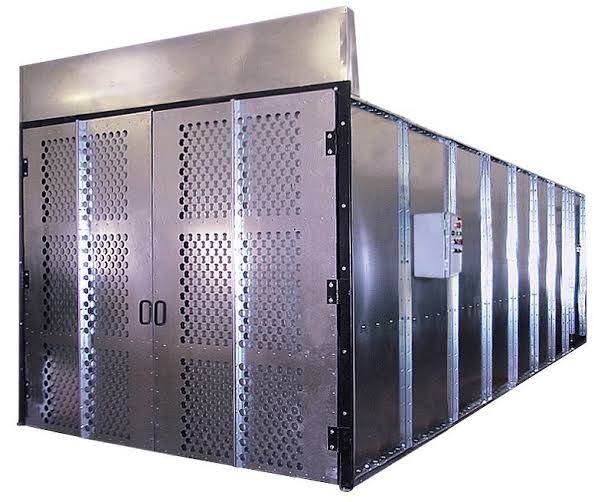
Curing equipment should accept parts at roughly the rate they leave the application stage. Reliant powder coating ovens need enough usable chamber volume to accommodate rack dimensions and production frequency without forcing coated parts to sit outside the oven longer than the workflow allows.
Metal thickness also changes oven demand because heavier parts take longer to reach the specified substrate temperature. Facilities with dense loads or large components may need a Reliant industrial powder coating oven sized around thermal mass, heat recovery, airflow, and required cure schedules rather than simple interior dimensions.
Color Changes Can Lower Effective Daily Capacity
Frequent color changes take production time away from spraying because crews may need to clean booth surfaces, purge hoses, service powder delivery components, and verify that the next color is free from contamination. Scheduling similar colors together can reduce cleaning frequency, but custom work often makes that approach difficult.
Labor and Material Handling Affect Equipment Output
Operators determine how quickly parts reach and leave each machine, particularly in batch systems that rely on carts, racks, or manual transfers. Extra lifting, narrow aisles, awkward turns, and insufficient staging space can make capable Reliant powder coating systems perform below their rated potential because equipment spends too much time waiting for the next load.
Better material flow reduces those idle periods by giving unfinished, coated, and cured parts clear places to move. Manufacturers reviewing Reliant powder coating equipment should account for rack loading time, transfer distances, cooling space, inspection points, and staffing levels when calculating realistic hourly production.
Should the System Be Sized for Future Growth?
Current demand matters, but equipment that operates near maximum capacity from its first month leaves little room for new customers, larger orders, or additional product lines. Allowing reasonable spare capacity can give a manufacturer room to increase output without replacing major finishing equipment soon after installation.
Match the Equipment Package to the Entire Workflow
Balanced systems perform better because booth capacity, curing speed, preparation, handling, and labor all support roughly the same production target. Buyers comparing a Reliant powder coating oven for sale or Reliant powder curing ovens should therefore calculate how many complete loads the entire line can finish per shift rather than focusing on one machine’s advertised capacity.
Reliant Finishing Systems provides Reliant powder coating equipment for manufacturers building new finishing operations or increasing existing output. Their booth, oven, and system options can be matched to actual part dimensions, rack loads, cure requirements, available space, production schedules, and growth plans, helping shops select equipment that supports useful throughput instead of adding capacity where it cannot be fully used.